


Sexual health is one of the most underserved areas in modern medicine. For decades, the conversation around low libido and sexual dysfunction has been limited to a narrow set of tools: testosterone for men, estrogen for women, and a small family of blood-flow medications like Viagra and Cialis that address the mechanical side of the equation while leaving the deeper issue of desire completely untouched.
What if the problem is not blood flow at all? What if the real issue is that the brain’s signal for desire has gone quiet?
That is exactly the question PT-141 was designed to answer. Also known by its clinical name bremelanotide, PT-141 is a peptide that works through an entirely different mechanism than anything most patients have tried before. It targets the central nervous system, specifically the hypothalamic pathways that regulate sexual arousal, motivation, and desire. Instead of forcing a physical response, it restores the neurological signal that makes you want to be intimate in the first place.
At Texas Center Wellness, sexual health is not treated as a standalone issue. It is part of a larger picture that includes hormonal balance, metabolic function, and overall vitality. PT-141 is one of the tools we use within personalized protocols built around your biology, and this post will explain exactly how it works, who it helps, and why it matters.
What Is PT-141?
PT-141 is a synthetic cyclic heptapeptide, a chain of seven amino acids arranged in a ring structure. It was derived from alpha-melanocyte-stimulating hormone (α-MSH), a naturally occurring hormone in the body that influences pigmentation, inflammation, and sexual behavior.
Its origin story is one of the more interesting chapters in peptide research. Scientists were initially studying a related compound called Melanotan II as a potential sunless tanning agent. During those early trials, participants began reporting a surprising and unrelated side effect: a notable increase in sexual arousal and desire. That unexpected observation led researchers to isolate the specific molecular structure responsible for the sexual response, and PT-141 was born.
In 2019, the FDA approved a version of PT-141 under the brand name Vyleesi for the treatment of hypoactive sexual desire disorder (HSDD) in premenopausal women. This made bremelanotide the first and only FDA-approved treatment that targets the neurological basis of sexual desire rather than the vascular or hormonal systems. While the official approval is specific to HSDD in premenopausal women, physicians now use PT-141 more broadly for both men and women who struggle with low libido and sexual dysfunction under careful clinical supervision.
How PT-141 Works: The Brain, Not the Blood Vessels
This is the critical distinction that separates PT-141 from every other treatment for sexual dysfunction that most patients have encountered.
Medications like sildenafil (Viagra) and tadalafil (Cialis) are PDE5 inhibitors. They work by relaxing blood vessels and increasing blood flow to the genitals. They can produce a physical response, but they do nothing to address desire. If the neurological “signal” for wanting intimacy has faded, these medications cannot bring it back. They enable the body, but they do not activate the mind.
PT-141 works at the source. When administered, it selectively activates melanocortin-3 and melanocortin-4 receptors (MC3R and MC4R) located in the hypothalamus and limbic regions of the brain. These are the areas that govern sexual behavior, motivation, and the experience of desire.
Here is what happens at the molecular level:
Melanocortin Receptor Activation
PT-141 binds to MC3R and MC4R receptors in the hypothalamus with high affinity. This triggers intracellular signaling cascades involving cyclic adenosine monophosphate (cAMP), which increases neuronal excitability in the brain’s sexual behavior control centers. In practical terms, the brain’s arousal pathways become more responsive to stimulation.
Dopamine Release
Research has documented that MC4R activation leads to dopamine release in the mesolimbic system, the brain’s reward and motivation circuit. Dopamine is the neurotransmitter most closely associated with desire, pleasure, and anticipation. When dopamine signaling diminishes, so does the drive for intimacy. PT-141 helps restore that signal from within the brain’s own chemistry.

Oxytocin Pathway Enhancement
PT-141 also stimulates neurons in the paraventricular nucleus (PVN), which is involved in oxytocin release. Oxytocin plays a central role in bonding, emotional connection, and the subjective experience of sexual satisfaction. This dual action on both dopamine and oxytocin pathways is part of what makes PT-141 feel qualitatively different from mechanical interventions. Patients frequently describe the response as more natural and spontaneous rather than forced.
Who Benefits from PT-141?
For Men
Sexual dysfunction in men is often reduced to a single issue: erectile function. But in my experience working with men’s health and bio-identical hormone optimization over many years, the picture is almost always more complex. Many men who come to Texas Center Wellness report that they can achieve an erection with medication, but the desire behind it has faded. The intimacy feels mechanical rather than driven by genuine want.
PT-141 addresses this directly. Because it works through the central nervous system rather than the vascular system, it is particularly valuable for men who:
Have not responded adequately to PDE5 inhibitors like Viagra or Cialis
Experience reduced libido alongside erectile challenges, not just one or the other
Are dealing with the sexual side effects of stress, aging, or medications such as antidepressants
Want to restore a sense of natural desire rather than relying solely on physical aids
Clinical research has shown statistically significant erectile responses in men at appropriate doses, with effects beginning approximately thirty minutes after administration. Importantly, PT-141 also triggers nitric oxide release, which supports penile blood flow alongside the central arousal response, giving it a dual mechanism that purely vascular medications do not offer.
For Women
Low libido in women is one of the most common and least adequately treated concerns in medicine. Hormonal fluctuations, life stages, stress, relationship dynamics, and neurotransmitter changes can all contribute to a persistent absence of sexual desire that causes real distress.
PT-141 earned its FDA approval specifically because clinical trials demonstrated meaningful improvement in desire and arousal scores among premenopausal women with HSDD. The approval of Vyleesi in 2019 marked a turning point: the first time the medical establishment formally acknowledged that sexual desire is a neurological event and that treating it requires a neurological solution.
For women, PT-141 may be appropriate when:
Low desire has persisted despite addressing hormonal balance and lifestyle factors
The lack of libido is causing personal distress or relational strain
Previous treatments have focused on physical function without addressing the mental and emotional component of desire
There is a desire for a non-hormonal option that works through the brain’s own pathways
How We Integrate PT-141 at Texas Center Wellness
Sexual health does not exist in isolation. Libido is downstream of hormonal balance, metabolic health, sleep quality, stress levels, and even gut function. Prescribing PT-141 without understanding the full picture would be like putting premium fuel in a car with a broken engine.
When a patient comes to us with concerns about sexual health, we begin with a comprehensive evaluation that includes:
Detailed medical history and symptom assessment, conducted in a confidential, judgment-free setting
Advanced diagnostic bloodwork to assess testosterone, estrogen, thyroid function, cortisol, DHEA, and other biomarkers that directly influence libido
A candid conversation about lifestyle factors: sleep patterns, stress load, nutrition, exercise, and medication use
An honest assessment of whether the concern is primarily physical, primarily neurological, or both
If PT-141 is appropriate, it is prescribed as part of a protocol that may also include bio-identical hormone replacement therapy to address underlying imbalances, nutritional optimization, and in some cases other peptides that support complementary pathways. For example, patients working on overall tissue repair and recovery may also benefit from BPC-157, which we covered in detail in a previous post on this blog.
What to Expect: How PT-141 Is Used
PT-141 is typically administered as a small subcutaneous injection approximately forty-five minutes before anticipated intimacy. It is an on-demand medication rather than a daily commitment, which many patients find appealing.
Key practical details:
Effects typically begin within thirty to sixty minutes of administration
The heightened sense of desire and arousal can last several hours, with some patients reporting effects up to twelve hours
A maximum of one dose per twenty-four hours is recommended, with no more than eight doses per month
Nasal spray formulations are also available for patients who prefer to avoid injections, though the subcutaneous route offers more consistent absorption
For patients using PT-141 at home, we provide detailed instructions, proper supplies, and ongoing support through our telehealth platform
Dosing is individualized. The FDA-approved dose of 1.75mg serves as a starting reference, but in clinical practice, we adjust based on body weight, individual sensitivity, and response. Every patient starts with a conservative test dose, and we titrate carefully from there.
Safety and Side Effects
PT-141 is generally well-tolerated when used as directed under medical supervision. The most commonly reported side effect is nausea, which occurs in a meaningful percentage of patients, particularly at higher doses. In most cases, the nausea is mild and resolves on its own. Starting with a lower dose and gradually increasing is the most effective strategy for minimizing this response.
Other potential side effects include flushing, headache, and a temporary increase in blood pressure. Because of the blood pressure consideration, PT-141 is not recommended for patients with uncontrolled hypertension or significant cardiovascular disease. It should also not be used concurrently with PDE5 inhibitors due to the risk of compounding blood pressure effects.
This is precisely why physician oversight matters. A qualified provider can screen for contraindications, establish appropriate dosing, and monitor your response over time to ensure the therapy is safe and effective for your specific situation.
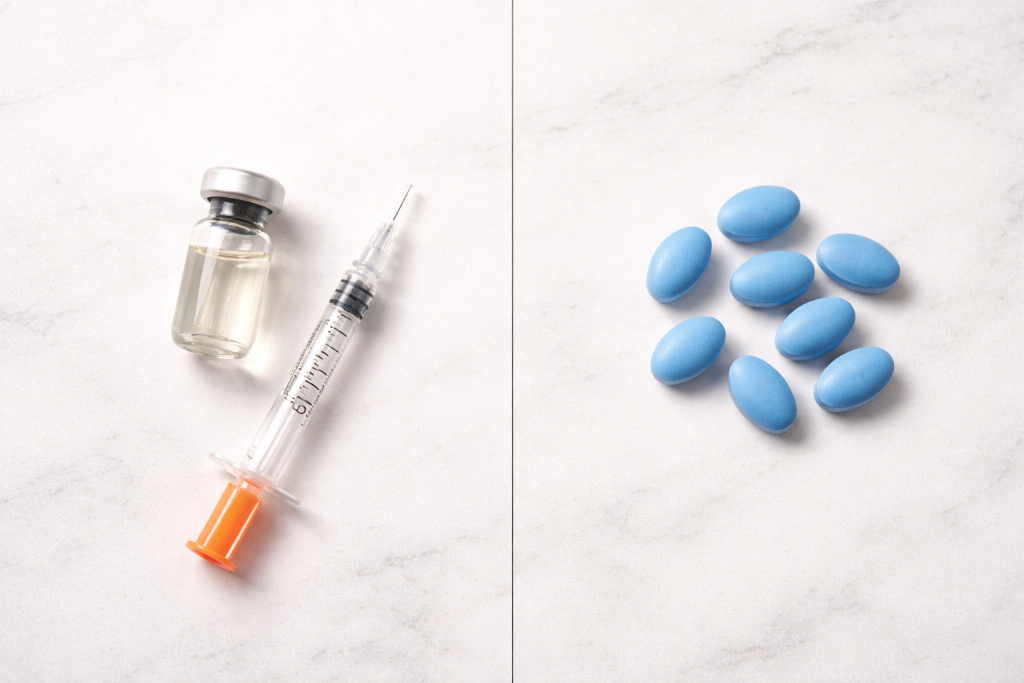
PT-141 vs. Traditional ED Medications: A Different Approach
Patients frequently ask how PT-141 compares to medications like Viagra or Cialis. The answer is that they are not really in competition with each other because they solve fundamentally different problems.
| PT-141 (Bremelanotide) | PDE5 Inhibitors (Viagra, Cialis) |
Primary Target | Central nervous system (brain) | Peripheral vascular system (blood vessels) |
What It Addresses | Sexual desire and arousal | Erectile function (blood flow) |
Mechanism | Melanocortin receptor activation → dopamine release | PDE5 inhibition → increased nitric oxide → blood flow |
Works For | Men and women | Primarily men |
Addresses Low Libido? | Yes — this is its primary function | No — does not affect desire |
Administration | Subcutaneous injection or nasal spray | Oral tablet |
Onset | 30–60 minutes | 30–60 minutes |
FDA Status | Approved as Vyleesi for HSDD (women); used off-label for men | Approved for erectile dysfunction |
For some patients, PT-141 alone is the right answer. For others, particularly men dealing with both desire and vascular erectile concerns, a combined approach may be appropriate, though never simultaneously in the same session due to blood pressure considerations. This is a decision that should be made with your physician based on your individual health profile.
Sexual Health Is Whole-Body Health
One of the principles I have carried through my entire career, from orthopaedic surgery to regenerative medicine, is that the body is a connected system. You cannot isolate one function and expect to fix it without understanding what is happening upstream.
Sexual desire is influenced by testosterone levels, thyroid function, cortisol balance, sleep quality, gut health, inflammation, and even nutritional status. A patient whose testosterone is significantly low is unlikely to see the full benefit of PT-141 until that foundation is addressed. Similarly, someone dealing with chronic stress and cortisol dysregulation may find that managing the stress response unlocks desire in ways that no single medication can achieve.
This is why every treatment plan at Texas Center Wellness starts with a complete picture. PT-141 is a powerful and unique tool, but it works best when it is part of a system that accounts for your hormones, your metabolism, your lifestyle, and your goals.
Ready to Explore PT-141?
If low libido or sexual dysfunction is affecting your quality of life or your relationships, you do not have to accept it as inevitable. PT-141 offers a scientifically grounded, physician-supervised option that addresses desire at its neurological source.
At Texas Center Wellness, conversations about sexual health are treated with the same clinical rigor and respect as any other area of your well-being. Whether you visit our Austin-area practice or connect through our secure telehealth platform serving seventeen states, we will take the time to understand your situation, evaluate your biology, and determine the right approach for you.
Schedule your confidential consultation at texascenterwellness.com
Medical Disclaimer
This article is for educational and informational purposes only and is not intended as medical advice. PT-141 (bremelanotide) is FDA-approved as Vyleesi for HSDD in premenopausal women. Use in men and other populations is considered off-label. All treatment decisions should be made in consultation with a qualified healthcare provider based on your individual health profile. Results vary by patient. Texas Center Wellness does not guarantee specific outcomes from any therapy.